



International keyword research often starts with an English keyword set, followed by translation for each market. That process is efficient, but it can miss the language customers use while evaluating options or preparing to act.
Google Ads search term data complements conventional keyword research with behavioral evidence. It connects queries with campaign context and outcomes, showing how intent varies by market, which questions deserve organic coverage and where the journey may be failing.
In this guide, I’ll show you how to connect each query with its market, destination and outcome without treating paid-search data as a complete view of demand.
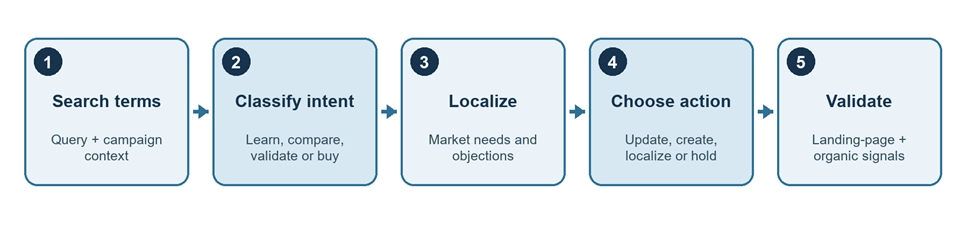
Build an evidence sheet, not a keyword dump
Use a reporting window that covers a normal sales cycle. Export search terms with campaign, ad group, impressions, clicks, cost, conversions, conversion value and device. Analyze geographic and landing-page reports separately, joining them at campaign or ad-group level when query-level pairing is unavailable. Direct search-term-to-landing-page reporting is available for Dynamic Search Ads and some AI Max views. Label geography as targeted or matched location. Matched locations may reflect a user’s physical location or a location of interest, so do not treat the two views as interchangeable.
Google distinguishes a search term, the words a user entered, from an advertiser’s keyword. The search terms report omits some low-activity queries for privacy. Search terms insights can group remaining demand into intent-based categories, including queries not exposed term by term.
Remove brand searches, obvious mismatches and terms tied to expired offers. Keep non-converters: a useful question may fail because the ad or landing page answered it poorly.
Classify the job behind each query
Look beyond a simple “informational” or “commercial” label. Ask what the person is trying to complete and which page would help.
| Search signal | Likely job | Suitable organic response |
| “What is,” “how does” or a problem description | Understand the issue | Explainer, guide or glossary |
| “X vs Y,” “best” or “alternative” | Compare approaches | Comparison page or buyer’s guide |
| Model, material, size or specification | Check suitability | Product page or technical FAQ |
| “Price,” “supplier,” “quote” or “near me” | Shortlist a seller | Commercial landing page |
| Country, currency, regulation or shipping term | Reduce local risk | Market-specific page or localized FAQ |
Read the full query, not one modifier. “Packaging machine price” is commercial; “how packaging machine pricing works” may signal early budgeting. The ad group and destination page add context.
Conversions strengthen the evidence but do not settle intent. A research query may influence a later sale, while a non-converter may simply have reached an irrelevant or incomplete page.
Localize the decision, not only the wording
International search behavior often changes around the practical conditions of a purchase. Two markets may use the same language yet care about different standards, delivery terms, currencies or product names.
Group data by country before combining close variants. Note the product nouns, applications, recurring specifications, commercial modifiers and local objections. Also compare the language used for research with the language used for purchase queries.
This determines whether a market needs translated copy, a localized section or a separate page. For different language versions, use separate URLs and connect localized equivalents with hreflang where appropriate.
A worked example (illustrative, not client data)
The following invented queries demonstrate the decision process. They do not represent a client campaign or claim measured results.
| Illustrative query | Market signal | Likely intent | Content action |
| industrial sealing machine price | United States; price modifier | Shortlist suppliers | Expand the commercial page with pricing factors and a clear quote process |
| automatic pouch sealer 230v | United Kingdom; voltage specification | Validate suitability | Add the 230V specification and a technical FAQ to the relevant product page |
| selladora industrial precio | Mexico; Spanish product term and price modifier | Compare and buy | Create or localize a Spanish commercial page with currency and delivery information |
Choose the right content action
A promising query does not automatically justify a new article. For each cluster, choose one action:
- Update an existing page.
- Create a commercial page.
- Create supporting editorial content.
- Add a localized section or FAQ.
- Hold or reject the idea.
Check four pieces of evidence:
- Demand: Does the theme appear consistently, or is it a one-off query?
- Intent: Is the searcher learning, comparing, validating or buying?
- Outcome quality: Did the traffic produce meaningful enquiries or sales, rather than merely clicks?
- Organic gap: Does Search Console show an existing page gaining impressions for the theme? If so, improvement may be safer than creating a competing URL.
Keep close variants that serve the same job on one strong page. Different intent needs different treatment: a technical explainer and a supplier page should not be forced into one URL.
Use landing-page behavior as editorial feedback
Search terms reveal the promise the visitor expected. Landing-page outcomes show whether the site kept it.
High ad engagement followed by weak conversion can indicate a mismatch rather than a bad topic. Review the page against the query:
- Does the opening confirm the searched product or problem?
- Is the requested specification easy to find?
- Are price variables, shipping coverage and next steps explained?
- Does the page offer evidence appropriate to that market?
- Is the mobile experience hiding details or obstructing the form?
A low-volume term producing qualified enquiries may deserve a focused page or FAQ. Paid data can reveal value that a keyword-volume estimate misses.
Bids, devices, tracking and sample size affect results. Treat each pattern as a reason to inspect the page, not proof of one cause.
Validate the content after publication
After publication, review queries, pages and countries together in Search Console. Use query text, country filters and page data to judge whether Google associates the page with the intended language and market, not merely whether one target keyword ranks.
Look for relevant new queries, impressions from the target country and cases where the wrong regional page appears. If organic visitors introduce better wording or new objections, return those insights to the ad team.
The resulting loop is straightforward:
- Paid search reveals current language and commercial signals.
- Content answers the underlying job.
- Landing-page behavior exposes gaps.
- Organic data shows how the page is understood.
- Both channels refine the next version.
Keep the limits visible
Search-term data is not a representative survey of a market. It reflects targeting, budget, keyword matching and ad eligibility, and query-level reporting is incomplete. Avoid treating the loudest campaign as the voice of every country.
Use it alongside Search Console, customer questions, sales feedback and local subject knowledge. Its value lies in connecting words to context, not replacing judgment.
This kind of cross-channel thinking is also part of how ZheShan Tech approaches international SEO: search language is treated as evidence of user intent rather than simply a translation task.
International SEO improves when content teams stop asking which keywords can be translated and start asking which decisions searchers are trying to make. Google Ads data can help answer that question, provided each query remains attached to its market, landing page and outcome.
Author Biography
Fucheng Zhang is a member of the team at ZheShan Tech, a China-based software and information technology company helping B2B and B2C businesses build and grow their international online presence. The company focuses on custom website development, international SEO, Google Ads, content marketing, and digital strategies designed to improve search visibility, website performance, and overseas customer acquisition.
Syeda Yasmeen is a Marketing & Digital Business Writer at Marketingiz, where she creates informative and practical content covering digital marketing, SEO, content strategy, branding, social media, online business and emerging digital trends.
View Full Profile →
Sameena Begum is a Marketing, Technology & Digital Content Reviewer at Marketingiz. She reviews selected articles to help ensure that information is presented clearly, accurately and responsibly.
View Full Profile →